by Jeff Goodell
So yesterday was the official publication day for my new book How to Cool the Planet, an event that I'd like to mark by ... taking a long nap. I'm only a few days into the book tour, but I'm already exhausted.
Not that I'm complaining. Being worn out by your book tour is a nice problem for a writer to have. Part of my fatigue is the result of a bumpy redeye from LA to NYC the other night; part of it can be blamed on a flood of questions from chemtrails conspiracy cultists who believe that Dark Forces are engaged in a secret plot to reduce the population of the planet by poisoning millions of people with aluminum particles dispersed in the sky. I'd like to have a sense of humor about this, but it's hard enough to have a serious discussion about geoengineering without having to fend off the black helicopter crowd.
I'm not bashing chemmies. I just want to talk about something more interesting: money.
Not surprisingly, the question of what role private capital might play in developing and deploying the hardware to cool off the planet came up at the Fortune Brainstorm Green conference in southern California I attended earlier this week. After all, geoengineering is the mother of all engineering projects. If we move forward with any of the various technologies that are now being discussed (a very big if), there's gonna be a lot of cash flying around. An obvious question: who will be the financial winners in a geoengineered world?
Here's my top five:
1. Lobbyists: Right now, because geoengineering is not much more than a twinkle in James Lovelock's eye, nobody on K street is pushing for Department of Energy funding of stratospheric aerosol injection devices. But in the future, they might be. Geoengineering could turn out to be the 21st century equivalent of industrial agriculture ... or a government project that has a lot in common with the overwrought, overfunded Star Wars missile defense system. Either way, lobbyists make out.
2. Carbon-sucking entrepreneurs: Here's a simple truth: anyone who figures out a cheap, simple way to suck CO2 out of the air is going to make a lot of money. Not surprisingly, a number of scientists/entrepreneurs are working on it, including David Keith, a physicist at the University of Calgary. Keith's company, called Carbon Engineering, uses a simple chemical process borrowed from the pulp industry, and has attracted $5 million in funding from investors, including Bill Gates. Right now, the cost of sucking carbon out of the air is up around $150 a ton, but if Keith -- or anyone else -- can cut that cost in half, things start to get interesting. And when it comes to geoengineering, CO2 removal is the one area where the profit motive is clearly lined up with the public good.
3. Early investors in albedo engineering companies: Manipulating the earth's albedo (a fancy word for reflectivity) by brightening clouds or injecting particles into the stratosphere is the most dangerous and complex type of geoengineering researchers are currently exploring. Among the many questions: Who is going to end up doing the actual work of brightening clouds or injecting aerosols? Maybe governments will be in charge, maybe a Richard Branson-like billionaire. Either way, the hardware is likely to be built by private contractors, just as the fighter planes used by the U.S. Air Force are built by private concerns like Lockheed Martin -- a company with a market cap right now of about $32 billion.
4. Geoengineering conference organizers: The whole idea of geoengineering is so fraught with technical, political, moral, and cultural complexities that, no matter how the future of geoengineering plays out, there are going to be plenty of issues to fret about. So we may as well gather up and fret together, even if we have to pay for the privilege.
5. Fundamentalist preachers: I'm not suggesting that religious leaders are motivated by money (or sex). However, if we start trying to deliberately manipulate the earth's climate, you can be sure that some will see this as trespassing into forbidden realms, and they will raise their voices against it. Imagine the war over abortion played out in the stratosphere and you'll have a pretty good idea where we might be headed.
-----
Editor's note: This is the third in a series of posts from Jeff Goodell, author of How to Cool the Planet: Geoengineering and the Audacious Quest to Fix Earth's Climate. Here's his first and second posts. And here's an interview with Goodell about his book, and an earlier interview about Big Coal.
Monday, April 19, 2010


How to Go Green Video
Cleaning up one’s life and helping clean up the environment at the same time really difficult. Remembering the little things goes a long way. Here are a few tips and reminders you can use to help protect the environment, in your everyday life.
Get rid off those "Energy Phantoms"
Protecting the environment and saving money is as easy as pulling the plug. There are appliances and electronic devices scattered around your home that are sucking electricity even when they aren’t in use. Who’d have thought that your cell phone charger could pull down an average of 1.73 Kilowatts per month; or that a printer absorbs 4.32 Kilowatts per month–just sitting there. May not seem like much, but if you add up all the items in your home that are secretly eating energy–it is a fairly large number.
Tucson Electric Power (TEP) has made the task of searching out and destroying the energy phantoms easy. Check out their energy phantom calculator. Just enter the quantity of each electronic device in your home and the calculator can quickly help you add up how much electricity each month is being wasted at your house. Now think about all the households in the U.S. The Census Bureau estimates that in 2007 there were 127,902,000 housing units in the country. I calculated a sampling of a few of these household items and the savings if they were unplugged.
Collective Usage of 127,902,000 Houses
kWh to be Saved Per month Millions $ to be Saved Per Month
Dishwasher 166,272,600 $15,348,240
Charger/power cube 184,178,880 16,627,260
Laptop charger 322,313,040 29,417,460
Doorbell 460,447,200 40,928,640
Microwave 276,268,320 24,302,380
Fax machine 856,943,400 76,741,200
Cell phone charger 221,270,460 20,464,320
Power & garden tool
charger 368,357,760 33,254,520
Multi-funct printer 552,536,640 49,881,780
I’m not suggesting that you have to unplug your microwave, doorbell or your dishwasher when they’re not in use (way too painful), but there are items that pulling the plug takes no more effort than flipping off a light switch. Figure out where you can unplug at your home. Collectively we can conserve millions of dollars worth of electricity and that little bit of effort can make a huge difference for the planet.
Tucson Electric Power (TEP) has made the task of searching out and destroying the energy phantoms easy. Check out their energy phantom calculator. Just enter the quantity of each electronic device in your home and the calculator can quickly help you add up how much electricity each month is being wasted at your house. Now think about all the households in the U.S. The Census Bureau estimates that in 2007 there were 127,902,000 housing units in the country. I calculated a sampling of a few of these household items and the savings if they were unplugged.
Collective Usage of 127,902,000 Houses
kWh to be Saved Per month Millions $ to be Saved Per Month
Dishwasher 166,272,600 $15,348,240
Charger/power cube 184,178,880 16,627,260
Laptop charger 322,313,040 29,417,460
Doorbell 460,447,200 40,928,640
Microwave 276,268,320 24,302,380
Fax machine 856,943,400 76,741,200
Cell phone charger 221,270,460 20,464,320
Power & garden tool
charger 368,357,760 33,254,520
Multi-funct printer 552,536,640 49,881,780
I’m not suggesting that you have to unplug your microwave, doorbell or your dishwasher when they’re not in use (way too painful), but there are items that pulling the plug takes no more effort than flipping off a light switch. Figure out where you can unplug at your home. Collectively we can conserve millions of dollars worth of electricity and that little bit of effort can make a huge difference for the planet.
Recycled Composite Decking
Splinter Free Living
Wooden decks and railings are hard to maintain, not to mention being splinter territory. What’s more, they’re not usually environmentally sustainable due to their use of premium forest products. For this reason alone Recycled composite decking is by far the best and coolest alternative to wood. This stuff looks like wood but feels like heaven. Manufactured from old plastic bottles makes it durable and resilient.

Dead Plastic Bottles Many manufacturers use a dense mixture of reclaimed plastic and wood fibers. One of the big companies in the industry, Trex, estimates that it prevents over 300,000 tons of plastic each year from ending up in the landfill. Billions of plastic bags from grocery stores are transformed into decking material instead of littering our streets and parks. Some companies, like Trex, take sustainability to the next level by operating their facilities with renewable energy and fueling their trucking fleets with biodiesel. Recycled Composite Decking is made of all sorts scrap wood and plastic, from sawdust to polyethylene (styrofoam) to milk cartons. In addition to decking, municipalities and businesses have discovered the benefits of using recycled composite material for park benches and picnic tables. Composites have certainly made their mark on college campuses across the country, as schools are embarking on reducing their environmental footprints.
Splintered wood
This material has a long life span, and won’t warp, rot, or crack. The days of restaining, refinishing, and seasounal repairs are gone. If you want a deck that is resistent to the elements yet promotes the integrity of the planet, then recycled composite is probably right for you.
Wooden decks and railings are hard to maintain, not to mention being splinter territory. What’s more, they’re not usually environmentally sustainable due to their use of premium forest products. For this reason alone Recycled composite decking is by far the best and coolest alternative to wood. This stuff looks like wood but feels like heaven. Manufactured from old plastic bottles makes it durable and resilient.

Dead Plastic Bottles Many manufacturers use a dense mixture of reclaimed plastic and wood fibers. One of the big companies in the industry, Trex, estimates that it prevents over 300,000 tons of plastic each year from ending up in the landfill. Billions of plastic bags from grocery stores are transformed into decking material instead of littering our streets and parks. Some companies, like Trex, take sustainability to the next level by operating their facilities with renewable energy and fueling their trucking fleets with biodiesel. Recycled Composite Decking is made of all sorts scrap wood and plastic, from sawdust to polyethylene (styrofoam) to milk cartons. In addition to decking, municipalities and businesses have discovered the benefits of using recycled composite material for park benches and picnic tables. Composites have certainly made their mark on college campuses across the country, as schools are embarking on reducing their environmental footprints.
Splintered wood
This material has a long life span, and won’t warp, rot, or crack. The days of restaining, refinishing, and seasounal repairs are gone. If you want a deck that is resistent to the elements yet promotes the integrity of the planet, then recycled composite is probably right for you.
Straw Bale Construction
From the Ground up, by a Single Mom
This is a great video from a single mom who built her own straw bale home for $50,000 while working still full time and living on the land. She gives some excellent advice here for anyone who is considering building their own straw bale home, from labor, to coding, to construction.
She also has a great website, HouseOfStraw.com, which I definitely recommend to anyone who is considering straw bale construction for their home, or sustainable green building in general. You will find great information, from someone who has been through it all.
Green Construction with Wind and Solar Energy
“Green Building” can mean more than just building environmentally-friendly or energy-efficient structures – clean energy and green techniques can also be used during the construction process itself. This videos show how 150 construction workers in Binghamton, New York are on the job without a single conventional generator in use. Instead, their entire project is powered by wind and solar energy systems. Needless to say, the final products of their work will be energy efficient as well.
The World’s Cheapest Car, Tata Nano: Boon or Bust for Environment?
The astoundingly cheap Nano is priced to sell at around $2,500 US, a price most of the middle-class in India can afford. Head of Tatan Motors, Ratan Tata, predicts the car will revolutionize travel in India, getting millions of Indian middle-class off dangerous motorcycles and into cars.
The Nano's Interior
Keep in mind, however, for only $2,500 you don’t get too many features: no power steering, no ABS, only one side mirror, and it tops out at about 65 mph. On the other hand, there is a feature those of us concerned about global warming might like. The car averages 45 mpg in the city and 75 mpg on the highway. Those aren’t bad numbers.
Yet, the possibly huge influx of cars this price tag represents around the world makes the environmental impact of the Nano look a little less positive. We are talking about MILLIONS of new cars. No matter how low the mpg’s, that will definitely add to already treacherous CO2 levels. Aren’t we supposed to be discouraging car purchases?

But then again, what can we say when the US is recklessly irresponsible in its gasoline consumption and automobile driving. Not to mention, the Nano presents the possibility of literally millions of people previously unable to afford cars getting behind the wheel at a relatively friendly mpg and GHG level. And this alone could beneficially stimulate the Indian economy in countless ways, resulting in the financial stability necessary to support more responsible environmental practices in a notoriously dirty country. Better small, green cars than SUVs, right?
What do you think? World’s cheapest care, boon or bust for environment?
The Nano's Interior
Keep in mind, however, for only $2,500 you don’t get too many features: no power steering, no ABS, only one side mirror, and it tops out at about 65 mph. On the other hand, there is a feature those of us concerned about global warming might like. The car averages 45 mpg in the city and 75 mpg on the highway. Those aren’t bad numbers.
Yet, the possibly huge influx of cars this price tag represents around the world makes the environmental impact of the Nano look a little less positive. We are talking about MILLIONS of new cars. No matter how low the mpg’s, that will definitely add to already treacherous CO2 levels. Aren’t we supposed to be discouraging car purchases?

But then again, what can we say when the US is recklessly irresponsible in its gasoline consumption and automobile driving. Not to mention, the Nano presents the possibility of literally millions of people previously unable to afford cars getting behind the wheel at a relatively friendly mpg and GHG level. And this alone could beneficially stimulate the Indian economy in countless ways, resulting in the financial stability necessary to support more responsible environmental practices in a notoriously dirty country. Better small, green cars than SUVs, right?
What do you think? World’s cheapest care, boon or bust for environment?
Create Your Own iPad Case with a Book!!

Create Your Own iPad Case with a Book
If you have an old hardcover book that’s gathering dust in the basement and you never plan to read it again, turn it into a hollow book and then use that secret compartment as a safe to hide your cash, cellphone or any other valuable items.
How to Make a Hollow Book
The iPad is this photograph is facing down but you can even invert the device and the hollow book case will then prevent your iPad back from getting scratches.
Make Magazine covered this trick in 2006 and it has become quite popular since then. If you don’t have the time to create a hollow book on your own, you can even order one online from Amazon.com.
Anyway, coming back to the iPad, the folks at CarryPad have come up with a brilliant idea – they suggest using an hollow book as a case for the Apple iPad.
The technique is more or less the same but you need to careful when choosing the book for the iPad case – it should have proper padding around the sides and the thickness of the book pages should be enough to support your iPad.
How eco-friendly is Mobile Internet?
Nokia says that updating your Facebook status from a mobile phone consumes about 100 times less energy than if you were to do the same activity from a desktop PC.
Also, if only 100 million people were to use mobile phones instead of desktop computers to browse the Internet one hour a day, the amount of energy saved would be roughly equivalent to the annual greenhouse gas emissions of 430,000 cars.
There are about 1.4 billion Internet users worldwide and around 46% of them use Internet from both PC and their mobile phones according to this chart from DataViz.
Also, if only 100 million people were to use mobile phones instead of desktop computers to browse the Internet one hour a day, the amount of energy saved would be roughly equivalent to the annual greenhouse gas emissions of 430,000 cars.
There are about 1.4 billion Internet users worldwide and around 46% of them use Internet from both PC and their mobile phones according to this chart from DataViz.
Sunday, April 18, 2010
Top 7 Eco-Friendly Mobile Phones
Let's not waste time on foreplay and get straight to business. Here are the top 7 green mobile phones I selected for my dear readers:
1. Sharp SH002 Solar Phone
This eco-friendly mobile phone provides a number of useful features like GPS and Bluetooth; besides, it's waterproof. The solar panel incorporated here requires only 30 minutes of sunlight exposure, to give you 140 minutes of standby and 2 minutes of communications. If you expose the phone to the sun for 90 minutes, you'll be able to communicate for 9 minutes or get 560 minutes of standby. The phone also has one interesting feature - Golf Mode, which unfortunately works only in Japan. It includes information on 2300 golf courses throughout the country, thus using the GPS you can get to the desired golf field.

2. LG Solar-Powered Phone
Another solar-powered mobile phone comes from LG. The device includes a solar-powered battery mounted into the back cover. Ten minutes of sunlight exposure allow you to talk for 10 minutes. Logically, the more you expose the phone to the sun the more talk time you get. In future the company hopes to pack its green devices into environmentally-friendly boxes, using recycled paper with cardboard that won't include laminate coating. In addition, the company wants to remove from the phone-manufacturing process such chemicals as brominated flame retardants (BFR), chlorinated flame retardants (CFR) and polyvinyl chloride (PVC) by 2010. This model also has the HFB-500 Bluetooth solar car kit that allows you to drive your car while talking on the phone without having to hold the device.

3. Samsung Blue Earth
Samsung unveiled an incredible eco-friendly phone with a full solar panel installed on its back, able to generate power when exposed to the sun. Besides, for an eco gadget the Blue Earth is quite small and comfortable to use. But Samsung went on with its device, making its body from recycle water bottles, without using brominated flame retardants, beryllium and phthalates. You can use the phone's features to turn on the energy saving mode, use a CO2 calculator, as well as a pedometer. The phone's packaging is made of recycled paper.

4. ZTE The Coral-200
The solar-powered device you see here comes from a Chinese mobile phone maker ZTE. Coral-200 represents a solar-powered handset that has one very important feature - its price, which is $ 40. The phone uses the Dutch-based technology and will help those who do not have access to regular power. One hour of sunlight exposure gives its users the possibility to talk for 15 minutes. It's not much considering the previous models, but it definitely catches on them with its (let's face it) incredible price. The company wants to sell its phone to 2 million people who do not have access to the energy network, which is why is achieved a partnership with Digicel, a network provider that does business in developing countries and provides solar-powered charges.

5. Natural Year Phone: Biodegradable Grass Handset
This device might look like a brick of grass, enriched with a keypad, but the Natural Year Phone concept developed by Je-Hyun Kim focuses on the lifecycle of mobile phones (which you don't see that often). After two years of functioning the bio phone degrades into pieces of grass so it would later be recycled - pretty weird, which is why it was listed here. What is worth mentioning here is that the phone biodegrades automatically, right after its two-year lifecycle ends. After that, the pieces can be recycled to create a new cellular phone.

6. Motorola Renew W233
Motorola registered a great slump in sales and it looks forward to come back among the best with a touch of eco-friendliness. With the world's first carbon neutral mobile phone the company wanted to show that it now pays more attention to e-waste. It is worth mentioning that Motorola's Renew W233 is the first certified Carbonfree mobile phone on the market today. It features a 100 percent recyclable case created from recycled water bottles. The phone includes a variety of other green features. After the phone reaches the end of its lifecycle, it can be recycled - all you have to do is place it in a prepaid envelope that comes with the box. Besides, the packaging uses 22 percent less material and the phone's manual is printed on a recycled paper with the help of soy-based ink.

7. Sony Ericsson C901 and Naite
The popular mobile phone manufacturer was not left behind in the field of eco-friendly gadgets. Recently it introduced two incredible phones, the Naite and the C901 cybershot phone. The "green" features of both models include reduced packaging, energy-saving chargers and 100 percent recycled headsets. Besides, you can recycle the phone as soon as you want another device. The paper manual is included in the headset, which eliminates the need of using paper and thus reducing the carbon footprint of the device by approximately 15 percent.

1. Sharp SH002 Solar Phone
This eco-friendly mobile phone provides a number of useful features like GPS and Bluetooth; besides, it's waterproof. The solar panel incorporated here requires only 30 minutes of sunlight exposure, to give you 140 minutes of standby and 2 minutes of communications. If you expose the phone to the sun for 90 minutes, you'll be able to communicate for 9 minutes or get 560 minutes of standby. The phone also has one interesting feature - Golf Mode, which unfortunately works only in Japan. It includes information on 2300 golf courses throughout the country, thus using the GPS you can get to the desired golf field.

2. LG Solar-Powered Phone
Another solar-powered mobile phone comes from LG. The device includes a solar-powered battery mounted into the back cover. Ten minutes of sunlight exposure allow you to talk for 10 minutes. Logically, the more you expose the phone to the sun the more talk time you get. In future the company hopes to pack its green devices into environmentally-friendly boxes, using recycled paper with cardboard that won't include laminate coating. In addition, the company wants to remove from the phone-manufacturing process such chemicals as brominated flame retardants (BFR), chlorinated flame retardants (CFR) and polyvinyl chloride (PVC) by 2010. This model also has the HFB-500 Bluetooth solar car kit that allows you to drive your car while talking on the phone without having to hold the device.

3. Samsung Blue Earth
Samsung unveiled an incredible eco-friendly phone with a full solar panel installed on its back, able to generate power when exposed to the sun. Besides, for an eco gadget the Blue Earth is quite small and comfortable to use. But Samsung went on with its device, making its body from recycle water bottles, without using brominated flame retardants, beryllium and phthalates. You can use the phone's features to turn on the energy saving mode, use a CO2 calculator, as well as a pedometer. The phone's packaging is made of recycled paper.

4. ZTE The Coral-200
The solar-powered device you see here comes from a Chinese mobile phone maker ZTE. Coral-200 represents a solar-powered handset that has one very important feature - its price, which is $ 40. The phone uses the Dutch-based technology and will help those who do not have access to regular power. One hour of sunlight exposure gives its users the possibility to talk for 15 minutes. It's not much considering the previous models, but it definitely catches on them with its (let's face it) incredible price. The company wants to sell its phone to 2 million people who do not have access to the energy network, which is why is achieved a partnership with Digicel, a network provider that does business in developing countries and provides solar-powered charges.

5. Natural Year Phone: Biodegradable Grass Handset
This device might look like a brick of grass, enriched with a keypad, but the Natural Year Phone concept developed by Je-Hyun Kim focuses on the lifecycle of mobile phones (which you don't see that often). After two years of functioning the bio phone degrades into pieces of grass so it would later be recycled - pretty weird, which is why it was listed here. What is worth mentioning here is that the phone biodegrades automatically, right after its two-year lifecycle ends. After that, the pieces can be recycled to create a new cellular phone.

6. Motorola Renew W233
Motorola registered a great slump in sales and it looks forward to come back among the best with a touch of eco-friendliness. With the world's first carbon neutral mobile phone the company wanted to show that it now pays more attention to e-waste. It is worth mentioning that Motorola's Renew W233 is the first certified Carbonfree mobile phone on the market today. It features a 100 percent recyclable case created from recycled water bottles. The phone includes a variety of other green features. After the phone reaches the end of its lifecycle, it can be recycled - all you have to do is place it in a prepaid envelope that comes with the box. Besides, the packaging uses 22 percent less material and the phone's manual is printed on a recycled paper with the help of soy-based ink.

7. Sony Ericsson C901 and Naite
The popular mobile phone manufacturer was not left behind in the field of eco-friendly gadgets. Recently it introduced two incredible phones, the Naite and the C901 cybershot phone. The "green" features of both models include reduced packaging, energy-saving chargers and 100 percent recycled headsets. Besides, you can recycle the phone as soon as you want another device. The paper manual is included in the headset, which eliminates the need of using paper and thus reducing the carbon footprint of the device by approximately 15 percent.

Friday, April 16, 2010
Solutions to Climate Change: Using Trees and Grasses to Capture Carbon and Produce Energy
(Jan. 29, 2010) — A unique £1.1 million research project is investigating how coppiced trees and grass crops can be used both to generate renewable energy and to trap carbon in the soil over the long term.
Led by Professor Gail Taylor, an expert on plants and the environment at the University of Southampton, a team of scientists across the UK will track the path of carbon, captured by plants and grasses through the process of photosynthesis, as it flows through the plant to the soil, which is inhabited by micro-organisms, before becoming locked into organic matter in the soil in which the plant is growing.
The team will also compare the process with that of arable food crops, such as wheat, and will test the idea that the 'bioenergy' crops are better at stimulating long-term retention of soil carbon.
Unlike existing food crops that are harvested after just a few months, trees and grasses can spend decades growing before they are harvested and release their trapped CO2, making the process more effective.
"Scientists now believe that CO2 is an important greenhouse gas and a major cause of climate change, so it's vital we develop ways of removing it from the atmosphere," comments Professor Gail Taylor, of the University's School of Biological Sciences.
"Using trees and grasses is an efficient and cost-effective way of doing this, whilst providing a source of energy and off-setting CO2 emissions from equivalent fossil fuels. Our research has already shown that bioenergy crops could potentially reduce carbon emissions by several million tonnes in the UK over the next decade."
'Carbon opportunity' maps will be developed to identify the optimum areas of the countryside in which bioenergy crops could most effectively be grown. The crops could then be combusted alongside coal in power stations to produce electricity, producing fewer CO2 emissions than fossil fuels, or used in heating systems.
"In the future, bioenergy crops could be turned into liquid fuels such as bioethanol, avoiding the conflict between food and fuel when grain crops are used for these purposes," adds Professor Taylor.
Story Source:
Adapted from materials provided by University of Southampton.
Led by Professor Gail Taylor, an expert on plants and the environment at the University of Southampton, a team of scientists across the UK will track the path of carbon, captured by plants and grasses through the process of photosynthesis, as it flows through the plant to the soil, which is inhabited by micro-organisms, before becoming locked into organic matter in the soil in which the plant is growing.
The team will also compare the process with that of arable food crops, such as wheat, and will test the idea that the 'bioenergy' crops are better at stimulating long-term retention of soil carbon.
Unlike existing food crops that are harvested after just a few months, trees and grasses can spend decades growing before they are harvested and release their trapped CO2, making the process more effective.
"Scientists now believe that CO2 is an important greenhouse gas and a major cause of climate change, so it's vital we develop ways of removing it from the atmosphere," comments Professor Gail Taylor, of the University's School of Biological Sciences.
"Using trees and grasses is an efficient and cost-effective way of doing this, whilst providing a source of energy and off-setting CO2 emissions from equivalent fossil fuels. Our research has already shown that bioenergy crops could potentially reduce carbon emissions by several million tonnes in the UK over the next decade."
'Carbon opportunity' maps will be developed to identify the optimum areas of the countryside in which bioenergy crops could most effectively be grown. The crops could then be combusted alongside coal in power stations to produce electricity, producing fewer CO2 emissions than fossil fuels, or used in heating systems.
"In the future, bioenergy crops could be turned into liquid fuels such as bioethanol, avoiding the conflict between food and fuel when grain crops are used for these purposes," adds Professor Taylor.
Story Source:
Adapted from materials provided by University of Southampton.
Toyota Highlander FCHV-adv: Travel 431 Miles On A Single Tank of H2.
It’s going be hard for Ford, Cadillac and other SUV manufacturers to tout their 18mpg “Green” vehicles in commercials and in print ads once the Toyota Highlander FCHV-adv hits the roadways. A vehicle that can handle 431 miles on a single 6 kilogram tank of H2. A number equal to 68.3 miles/kg when compared to miles per gallon.
According to AutoblogGreen, “Toyota representatives and others drove two FCHV-advs from Torrance to San Diego and back, a 331.5 mile trip, and then calculated how much H2 was left in the 10,000 psi tank.”

It was also announced by a Toyota representative that the company plans on bringing a durable fuel cell vehicle to market by 2015. That’s not even the best news, there are claims that the vehicle will be priced “shockingly low” for consumers.
Currently tests are still underway in California, which means fuel economy may increase at an even greater rate before Toyota releases their first H2 capable automobiles.
So just remember, when commercials are touting 18 miles per gallon SUV’s their about 4 times behind the fold, not to mention the government calls 18mpg vehicles “Clunkers” in their new “CARS” program.
According to AutoblogGreen, “Toyota representatives and others drove two FCHV-advs from Torrance to San Diego and back, a 331.5 mile trip, and then calculated how much H2 was left in the 10,000 psi tank.”

It was also announced by a Toyota representative that the company plans on bringing a durable fuel cell vehicle to market by 2015. That’s not even the best news, there are claims that the vehicle will be priced “shockingly low” for consumers.
Currently tests are still underway in California, which means fuel economy may increase at an even greater rate before Toyota releases their first H2 capable automobiles.
So just remember, when commercials are touting 18 miles per gallon SUV’s their about 4 times behind the fold, not to mention the government calls 18mpg vehicles “Clunkers” in their new “CARS” program.
Microbes galore in seas; "spaghetti" mats Pacific
Alister Doyle, Environment CorrespondentPosted April 2010
OSLO, Apr. 18, 2010 (Reuters) — The ocean depths are home to myriad species of microbes, mostly hard to see but including spaghetti-like bacteria that form whitish mats the size of Greece on the floor of the Pacific, scientists said on Sunday.
The survey, part of a 10-year Census of Marine Life, turned up hosts of unknown microbes, tiny zooplankton, crustaceans, worms, burrowers and larvae, some of them looking like extras in a science fiction movie and underpinning all life in the seas.
"In no other realm of ocean life has the magnitude of Census discovery been as extensive as in the world of microbes," said Mitch Sogin of the Marine Biological Laboratory in Woods Hole, Massachusetts, head of the marine microbe census.
The census estimated there were a mind-boggling "nonillion" -- or 1,000,000,000,000,000,000,000,000,000,000 (30 zeroes) -- individual microbial cells in the oceans, weighing as much as 240 billion African elephants, the biggest land animal.
Getting a better idea of microbes, the "hidden majority" making up 50 to 90 percent of biomass in the seas, will give a benchmark for understanding future shifts in the oceans, perhaps linked to climate change or pollution.
Among the biggest masses of life on the planet are carpets on the seabed formed by giant multi-cellular bacteria that look like thin strands of spaghetti. They feed on hydrogen sulphide in oxygen-starved waters in a band off Peru and Chile.
"Fishermen sometimes can't lift nets from the bottom because they have more bacteria than shrimp," Victor Gallardo, vice chair of the Census Scientific Steering Committee, told Reuters. "We've measured them up to a kilo (2.2 lbs) per square meter."
GHOSTLY MATS
The census said they carpeted an area the size of Greece -- about 130,000 sq km (50,000 sq miles) or the size of the U.S. state of Alabama. Toxic to humans, the bacteria are food for shrimp or worms and so underpin rich Pacific fish stocks.
The bacteria had also been found in oxygen-poor waters off Panama, Ecuador, Namibia and Mexico as well as in "dead zones" under some salmon farms. They were similar to ecosystems on earth that thrived from 2.5 billion to 650 million years ago.
Overall in the oceans, up to a billion microbe species may await identification under the Census, an international 10-year project due for completion in October 2010.
Tiny life was found everywhere, including at thermal vents with temperatures at 150 Celsius (300F) or in rocks 1,626 meters (5,335 ft) below the sea floor. Many creatures lack names or are hard to pronounce like loriciferans, polychaetes or copepods.
One major finding was that rare microbes are often found in samples where they can be outnumbered 10,000 to one by more common species. Isolated microbes may be lying in wait for a change in conditions that could bring a population boom.
Ann Bucklin, head of the Census of Marine Zooplankton that include tiny transparent crustaceans or jellyfish, said the seas were barely studied even by the census.
"Seventy percent of the oceans are deeper than 1,000 meters," Bucklin, of the University of Connecticut, told Reuters. "The deep layer is the source of the hidden diversity."
Paul Snelgrove, of Memorial University in Canada, said one sample in the South Atlantic in an area the size of a small bathroom -- 5.4 square meters -- turned up 700 species of copepod, a type of crustacean, 99 percent of them unfamiliar.
Just finding Latin names for each find will be hard. Scientists had rejected the idea of raising funds by letting people pay to have a marine "bug" named after them.
OSLO, Apr. 18, 2010 (Reuters) — The ocean depths are home to myriad species of microbes, mostly hard to see but including spaghetti-like bacteria that form whitish mats the size of Greece on the floor of the Pacific, scientists said on Sunday.
The survey, part of a 10-year Census of Marine Life, turned up hosts of unknown microbes, tiny zooplankton, crustaceans, worms, burrowers and larvae, some of them looking like extras in a science fiction movie and underpinning all life in the seas.
"In no other realm of ocean life has the magnitude of Census discovery been as extensive as in the world of microbes," said Mitch Sogin of the Marine Biological Laboratory in Woods Hole, Massachusetts, head of the marine microbe census.
The census estimated there were a mind-boggling "nonillion" -- or 1,000,000,000,000,000,000,000,000,000,000 (30 zeroes) -- individual microbial cells in the oceans, weighing as much as 240 billion African elephants, the biggest land animal.
Getting a better idea of microbes, the "hidden majority" making up 50 to 90 percent of biomass in the seas, will give a benchmark for understanding future shifts in the oceans, perhaps linked to climate change or pollution.
Among the biggest masses of life on the planet are carpets on the seabed formed by giant multi-cellular bacteria that look like thin strands of spaghetti. They feed on hydrogen sulphide in oxygen-starved waters in a band off Peru and Chile.
"Fishermen sometimes can't lift nets from the bottom because they have more bacteria than shrimp," Victor Gallardo, vice chair of the Census Scientific Steering Committee, told Reuters. "We've measured them up to a kilo (2.2 lbs) per square meter."
GHOSTLY MATS
The census said they carpeted an area the size of Greece -- about 130,000 sq km (50,000 sq miles) or the size of the U.S. state of Alabama. Toxic to humans, the bacteria are food for shrimp or worms and so underpin rich Pacific fish stocks.
The bacteria had also been found in oxygen-poor waters off Panama, Ecuador, Namibia and Mexico as well as in "dead zones" under some salmon farms. They were similar to ecosystems on earth that thrived from 2.5 billion to 650 million years ago.
Overall in the oceans, up to a billion microbe species may await identification under the Census, an international 10-year project due for completion in October 2010.
Tiny life was found everywhere, including at thermal vents with temperatures at 150 Celsius (300F) or in rocks 1,626 meters (5,335 ft) below the sea floor. Many creatures lack names or are hard to pronounce like loriciferans, polychaetes or copepods.
One major finding was that rare microbes are often found in samples where they can be outnumbered 10,000 to one by more common species. Isolated microbes may be lying in wait for a change in conditions that could bring a population boom.
Ann Bucklin, head of the Census of Marine Zooplankton that include tiny transparent crustaceans or jellyfish, said the seas were barely studied even by the census.
"Seventy percent of the oceans are deeper than 1,000 meters," Bucklin, of the University of Connecticut, told Reuters. "The deep layer is the source of the hidden diversity."
Paul Snelgrove, of Memorial University in Canada, said one sample in the South Atlantic in an area the size of a small bathroom -- 5.4 square meters -- turned up 700 species of copepod, a type of crustacean, 99 percent of them unfamiliar.
Just finding Latin names for each find will be hard. Scientists had rejected the idea of raising funds by letting people pay to have a marine "bug" named after them.
Thursday, April 15, 2010
Geography of Human Disease: Environment Has Much to Do With Surrounding Pathogens
If your home region has a hot, wet climate and a lot of different kinds of birds and mammals living in it, there's a really good chance the region will also contain numerous kinds of pathogens that cause human diseases.
A new study examining the geography of human disease, led by Dr. Rob Dunn at North Carolina State University alongside an international team of biologists and social scientists, shows that that one can predict the number of kinds of disease-causing pathogens in a region just by knowing its climate or the number of birds and mammals found there. Multiple things, Dunn says, might influence the diversity of pathogens in a region: human population size and density, the amount of time people have lived there or expenditures on disease control. Each of these undoubtedly has some influence, but the environment is dominant.
"We imagine that we have nature under control, but nobody seems to have told nature," Dunn says. "The environment and, in its broadest sense, nature determines the number of kinds of diseases in different regions of the world in much the way that it has influenced the number of kinds of birds, mammals, ants or bees."
But while the environment determines how many diseases one finds in a region, it does not determine how common they are. The researchers also examined the factors correlated to the prevalence, or commonness, of human pathogens across the globe and discovered that the most important factor is health-care spending, specifically expenditures on disease control.
"On the one hand, we are not very effective at altering the numbers of kinds of pathogens present, as those numbers are strongly correlated with environmental conditions. The vagaries of climate and life over which we have little control determine which diseases you are at risk of contracting in any given place," Dunn says. "But on the other hand, we can control the prevalence of pathogens by spending money on disease-control efforts. It is that prevalence that influences human health and well-being."
A paper describing the research appears online in Proceedings of the Royal Society of London: B, a leading peer-reviewed biology journal.
The study examined a host of factors thought to be involved in the global distribution of disease-carrying organisms. Climate and geographic variables, population data, disease-control data, pathogen data and human history data were all factored into statistical models that attempted to show which factors had stronger correlations to disease.
Geographic regions with lots of different kinds of birds and mammals are correlated with the presence of lots of pathogens. The most likely explanation for this relationship is simply that the same environmental factors have influenced patterns in diversity of human pathogens that have patterns in the diversity of the rest of life, including the birds and mammals. Reducing bird and mammal diversity will not remove the diseases, Dunn asserts. In fact, making wild birds and mammals more rare seems likely to increase the diversity of human diseases, with diseases on rare mammals and birds all too eager to jump from their sinking ships.
But all is not lost if you live in hotter and wetter climes with lots of birds and mammals around. Dunn points to life in the United States as one example. Malaria is present but is rare and relatively insignificant because of the country's historic effort at controlling disease. In short, the United States has a large number of different kinds of pathogens, Dunn says, but pathogen prevalence is low because of a strong history of disease-control and health-care spending.
The researchers also suggest ways to optimize future spending. In particular, places where current spending is low and populations are large are likely to be places where the most people will be saved by additional efforts -- notably India, Pakistan and East African nations along the equator. "Current health-care spending is quite low, prevalence of pathogens is quite high, and human populations are large in these areas, so it makes sense to target efforts there," Dunn says.
A new study examining the geography of human disease, led by Dr. Rob Dunn at North Carolina State University alongside an international team of biologists and social scientists, shows that that one can predict the number of kinds of disease-causing pathogens in a region just by knowing its climate or the number of birds and mammals found there. Multiple things, Dunn says, might influence the diversity of pathogens in a region: human population size and density, the amount of time people have lived there or expenditures on disease control. Each of these undoubtedly has some influence, but the environment is dominant.
"We imagine that we have nature under control, but nobody seems to have told nature," Dunn says. "The environment and, in its broadest sense, nature determines the number of kinds of diseases in different regions of the world in much the way that it has influenced the number of kinds of birds, mammals, ants or bees."
But while the environment determines how many diseases one finds in a region, it does not determine how common they are. The researchers also examined the factors correlated to the prevalence, or commonness, of human pathogens across the globe and discovered that the most important factor is health-care spending, specifically expenditures on disease control.
"On the one hand, we are not very effective at altering the numbers of kinds of pathogens present, as those numbers are strongly correlated with environmental conditions. The vagaries of climate and life over which we have little control determine which diseases you are at risk of contracting in any given place," Dunn says. "But on the other hand, we can control the prevalence of pathogens by spending money on disease-control efforts. It is that prevalence that influences human health and well-being."
A paper describing the research appears online in Proceedings of the Royal Society of London: B, a leading peer-reviewed biology journal.
The study examined a host of factors thought to be involved in the global distribution of disease-carrying organisms. Climate and geographic variables, population data, disease-control data, pathogen data and human history data were all factored into statistical models that attempted to show which factors had stronger correlations to disease.
Geographic regions with lots of different kinds of birds and mammals are correlated with the presence of lots of pathogens. The most likely explanation for this relationship is simply that the same environmental factors have influenced patterns in diversity of human pathogens that have patterns in the diversity of the rest of life, including the birds and mammals. Reducing bird and mammal diversity will not remove the diseases, Dunn asserts. In fact, making wild birds and mammals more rare seems likely to increase the diversity of human diseases, with diseases on rare mammals and birds all too eager to jump from their sinking ships.
But all is not lost if you live in hotter and wetter climes with lots of birds and mammals around. Dunn points to life in the United States as one example. Malaria is present but is rare and relatively insignificant because of the country's historic effort at controlling disease. In short, the United States has a large number of different kinds of pathogens, Dunn says, but pathogen prevalence is low because of a strong history of disease-control and health-care spending.
The researchers also suggest ways to optimize future spending. In particular, places where current spending is low and populations are large are likely to be places where the most people will be saved by additional efforts -- notably India, Pakistan and East African nations along the equator. "Current health-care spending is quite low, prevalence of pathogens is quite high, and human populations are large in these areas, so it makes sense to target efforts there," Dunn says.
Wednesday, April 14, 2010
Roll-up for the world’s largest mangrove planting project
Roll-up for the world’s largest mangrove planting project
Seeds of conservation success in Sandicoly, Senegal
Written by Tim
"Become a superhero, plant your mangrove today”, declared the poster.

Eager to enter the pantheon of mangrove superheroes we headed to the Saloum Delta in Senegal where the world’s largest ever mangrove planting project is underway. Organised by local NGO, Oceanium, almost 30 million mangroves have been planted since June.
The mangrove itself is a hero among flora. It provides firewood for cooking and smoking fish, branches for tortoise-shaped village rooftops, and breeding grounds for countless species of fish, including oysters that cling stubbornly to the mangroves’ spider-like roots.
Abdoulaye Diouf, Chef de Zone in Sandicoly, tells us that the fishermen had noticed a decline in the number of fish in recent years. This was attributed to over-fishing and a decline in mangrove coverage caused by unseasonal heavy rains.
As well as replenishing depleted mangrove stocks, Jean Goepp, Oceanium’s Project Coordinator, says that the project teaches people to conserve their resources. “People must re-plant their common resources, not just their gardens”, he says. Mr Diouf says the village is now aware that it must use all its resources sustainably – sea, forest and mangroves.
The mangroves were chosen as the resource to launch this behaviour-changing initiative because once planted they require no human input. Occupying the swampy inter-tidal zone they require no watering and are naturally protected from bush fires and hungry cattle.
80,000 people have been involved in the project, planting and collecting seedlings from the flowering mangrove trees for which they are paid 1,000 CFA (about £1.50) per sack. Oceanium provides a financial incentive to the community as well.
Planting is simple. You create a hole in the wet inter-tidal sand with an extended index finger and plug it with a seedling. Superhero status is easily attained.

In Sandicoly, the project has been accompanied by footballing success and the village is through to the regional cup final. They plan to use the mangrove money to take their supporters to the match. It will be ice creams all round as m
Seeds of conservation success in Sandicoly, Senegal
Written by Tim
"Become a superhero, plant your mangrove today”, declared the poster.

Eager to enter the pantheon of mangrove superheroes we headed to the Saloum Delta in Senegal where the world’s largest ever mangrove planting project is underway. Organised by local NGO, Oceanium, almost 30 million mangroves have been planted since June.
The mangrove itself is a hero among flora. It provides firewood for cooking and smoking fish, branches for tortoise-shaped village rooftops, and breeding grounds for countless species of fish, including oysters that cling stubbornly to the mangroves’ spider-like roots.
Abdoulaye Diouf, Chef de Zone in Sandicoly, tells us that the fishermen had noticed a decline in the number of fish in recent years. This was attributed to over-fishing and a decline in mangrove coverage caused by unseasonal heavy rains.
As well as replenishing depleted mangrove stocks, Jean Goepp, Oceanium’s Project Coordinator, says that the project teaches people to conserve their resources. “People must re-plant their common resources, not just their gardens”, he says. Mr Diouf says the village is now aware that it must use all its resources sustainably – sea, forest and mangroves.
The mangroves were chosen as the resource to launch this behaviour-changing initiative because once planted they require no human input. Occupying the swampy inter-tidal zone they require no watering and are naturally protected from bush fires and hungry cattle.
80,000 people have been involved in the project, planting and collecting seedlings from the flowering mangrove trees for which they are paid 1,000 CFA (about £1.50) per sack. Oceanium provides a financial incentive to the community as well.
Planting is simple. You create a hole in the wet inter-tidal sand with an extended index finger and plug it with a seedling. Superhero status is easily attained.
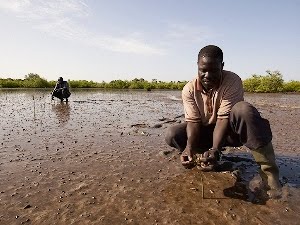
In Sandicoly, the project has been accompanied by footballing success and the village is through to the regional cup final. They plan to use the mangrove money to take their supporters to the match. It will be ice creams all round as m
Solar Powered Air Conditioners Coming To US Homes (Soon!)
Solar Powered Air Conditioners Coming To US Homes (Soon!)
Even though we are nearing the end of Summer, in many cities and states heat is still bearing down at full throttle.
And most homes in the US use air conditioners to cool off. In fact, most Americans use air conditioners to the tune of 16% of the total energy in the US. So obviously this is a huge market in the HVAC niche, which environmentalists and green minded entrepreneurs are rushing off to make more eco friendly. I don’t foresee anytime soon a plethora of middle Americans dumping their A/C, as this has been the norm for too long and most don’t know what to replace their A/C with. But there is growing awareness of the need to use less energy and to at least try energy-efficient cooling systems, and Americans are starting to seriously pay attention to this big energy hog.
However there is good news. A company named ChromaSun is making strides in this area and has a prototype in the works to bring a highly efficient earth-friendly air conditioner to US homes.
Their first revolutionary product is a Solar Powered Air Conditioner. This 10 foot long by 4 foot wide box (for lack of a better word) would cost about $15.52 a kilowatt hour to operate compared to $27.69 for an electrical air conditioner. And would cool off an average 1,500 square foot room with ease, according to ChromaSun. As the name suggests, the a/c would be powered by the Sun. The light from the sun would be converted to heat, which would then be converted to electricity. So you could potentially (very soon) cool off your home entirely off-grid. Or mostly off-grid anyway.
The cost has not yet been determined, nor a release date set on this solar-powered air conditioner, but keep an eye on ChromaSun—as they have a pulse on this massive and exciting industry.
Even though we are nearing the end of Summer, in many cities and states heat is still bearing down at full throttle.
And most homes in the US use air conditioners to cool off. In fact, most Americans use air conditioners to the tune of 16% of the total energy in the US. So obviously this is a huge market in the HVAC niche, which environmentalists and green minded entrepreneurs are rushing off to make more eco friendly. I don’t foresee anytime soon a plethora of middle Americans dumping their A/C, as this has been the norm for too long and most don’t know what to replace their A/C with. But there is growing awareness of the need to use less energy and to at least try energy-efficient cooling systems, and Americans are starting to seriously pay attention to this big energy hog.
However there is good news. A company named ChromaSun is making strides in this area and has a prototype in the works to bring a highly efficient earth-friendly air conditioner to US homes.
Their first revolutionary product is a Solar Powered Air Conditioner. This 10 foot long by 4 foot wide box (for lack of a better word) would cost about $15.52 a kilowatt hour to operate compared to $27.69 for an electrical air conditioner. And would cool off an average 1,500 square foot room with ease, according to ChromaSun. As the name suggests, the a/c would be powered by the Sun. The light from the sun would be converted to heat, which would then be converted to electricity. So you could potentially (very soon) cool off your home entirely off-grid. Or mostly off-grid anyway.
The cost has not yet been determined, nor a release date set on this solar-powered air conditioner, but keep an eye on ChromaSun—as they have a pulse on this massive and exciting industry.
Measuring Global Water Vapor and Formaldehyde
ScienceDaily (Apr. 14, 2010) — Atmospheric water vapour (H2O) is the most important natural greenhouse gas, accounting for about two-thirds of the natural greenhouse effect. Despite this importance, its role in climate and its reaction to climate change are still difficult to assess.

Many details of the hydrological cycle are poorly understood, such as the process of cloud formation and the transport and release of latent heat contained in the water vapour. In contrast to other important greenhouse gases like carbon dioxide (CO2) and methane, water vapour has a much higher temporal and spatial variability.
Global monitoring of H2O by Metop-A -- Europe’s first polar-orbiting meteorological satellite -- is therefore a key to understanding its impact on climate.
Formaldehyde (HCHO) is one of the most abundant hydrocarbons in the atmosphere and is an important indicator of so-called non-methane volatile organic compound (NMVOC) emissions and photochemical activity. As such, it is an indicator of the presence of volatile organic compounds in the atmosphere, which in turn play an important role in the formation of toxic ozone close to the surface and also have an important influence on climate through the formation of large aerosol particles. HCHO is a primary emission product from biomass burning and fossil fuel combustion, but its principle source in the atmosphere is the photochemical oxidation of methane and non-methane hydrocarbons. Metop-A measurements of HCHO can be used to constrain NMVOC emissions in current state-of-the-art chemical transport models used in the forecasting and analysis of pollution events and also in modelling climate change.
Operational GOME-2 H2O and HCHO data are being produced by the Deutsches Zentrum für Luft- und Raumfahrt (DLR), the German Aerospace Center, a partner of EUMETSAT's Ozone and Atmospheric Chemistry Monitoring SAF (O3M-SAF) coordinated by the Finnish Meteorological Institute. The H2O and HCHO retrieval algorithms for GOME-2 have been developed by the Max Planck Institute for Chemistry in Mainz, Germany, and the Belgian Institute for Space Aeronomy (BIRA/IASB) in Brussels, respectively.
GOME-2 H2O and HCHO as well as other operational products can be ordered via the O3M-SAF site. DLR provides near-real-time and historical maps of GOME-2 total column (ozone, nitrogen dioxide, tropospheric nitrogen dioxide, bromine oxide, sulphur dioxide, H2O, HCHO) and cloud products.

Many details of the hydrological cycle are poorly understood, such as the process of cloud formation and the transport and release of latent heat contained in the water vapour. In contrast to other important greenhouse gases like carbon dioxide (CO2) and methane, water vapour has a much higher temporal and spatial variability.
Global monitoring of H2O by Metop-A -- Europe’s first polar-orbiting meteorological satellite -- is therefore a key to understanding its impact on climate.
Formaldehyde (HCHO) is one of the most abundant hydrocarbons in the atmosphere and is an important indicator of so-called non-methane volatile organic compound (NMVOC) emissions and photochemical activity. As such, it is an indicator of the presence of volatile organic compounds in the atmosphere, which in turn play an important role in the formation of toxic ozone close to the surface and also have an important influence on climate through the formation of large aerosol particles. HCHO is a primary emission product from biomass burning and fossil fuel combustion, but its principle source in the atmosphere is the photochemical oxidation of methane and non-methane hydrocarbons. Metop-A measurements of HCHO can be used to constrain NMVOC emissions in current state-of-the-art chemical transport models used in the forecasting and analysis of pollution events and also in modelling climate change.
Operational GOME-2 H2O and HCHO data are being produced by the Deutsches Zentrum für Luft- und Raumfahrt (DLR), the German Aerospace Center, a partner of EUMETSAT's Ozone and Atmospheric Chemistry Monitoring SAF (O3M-SAF) coordinated by the Finnish Meteorological Institute. The H2O and HCHO retrieval algorithms for GOME-2 have been developed by the Max Planck Institute for Chemistry in Mainz, Germany, and the Belgian Institute for Space Aeronomy (BIRA/IASB) in Brussels, respectively.
GOME-2 H2O and HCHO as well as other operational products can be ordered via the O3M-SAF site. DLR provides near-real-time and historical maps of GOME-2 total column (ozone, nitrogen dioxide, tropospheric nitrogen dioxide, bromine oxide, sulphur dioxide, H2O, HCHO) and cloud products.
Tuesday, April 13, 2010
Dust, vanishing greenery threaten Taj

Agra: The Taj Mahal and other heritage monuments in and around Agra are facing a major threat from dust-laden air. Unabated construction is making the city's green cover disappear and drying up water bodies, adding to the dust levels.
"The collision (of the dust with the marble) results in micro-scratches that retain moisture which attracts pollutants and gaseous substances," said PC Gupta, head of the Archaeological Survey of India's (ASI) chemical department.
The dry westerlies from the Rajasthan desert are sand-blasting the white marble mausoleum and the first question in the minds of many tourists visiting the Taj is whether it is turning yellow?
The suspended particulate matter (SPM) level in the ambient air around the Taj Mahal is over 350 micrograms per cubic metre, much above the permissible standard of 100. In the city and around other monuments, it could be much higher, Gupta told a news agency.
The chief reasons are the rapid increase in vehicular movement, lack of water in Yamuna river and poor afforestation on the western periphery of the city, he said.
Surendra Sharma, president of Braj Mandal Heritage Conservation Society, questioned the success and validity of a whole lot of exercises undertaken to bring down the air pollution level when the SPM and dust levels have not come down.
The abnormally high temperature in March and April have dried up all water sources and the dust storms have raised the SPM level to a new high.
Mughal emperor Akbar's abandoned capital at Fatehpur Sikri is equally threatened by illegal mining activity all around and lack of water to green the surroundings.
No government department has any idea or plan to remove the garbage dumps that have come up on 80 acres of the incomplete Taj Heritage corridor - work on which was ordered to be stopped by the Supreme Court in 2003 - between the Taj and the Agra Fort.
"The Supreme Court has done justice by staying the development of corridor at the site. However, the unfinished project is actually causing lots of environmental problems," said Ritesh K Sharma, an activist of rights group LegalMitra.
Central Pollution Control Board (CPCB) officials have said repeatedly that the dust level in the whole Taj trapezium cannot come down until there is massive tree plantation all around and water in the river Yamuna round the year. The ASI last year sent a proposal for a barrage on the river but no action has been taken.
Despite crores of rupees spent over the past 15 years, the Yamuna behind the Taj is still dry. Urging efforts to save the river, Mughal historian R Nath said: "The water in the river will absorb all the pollution and dust and also strengthen the base of the massive structure."
Stretches of green cover along the Western periphery of the city and the southern side have vanished to make way for residential colonies. Community ponds have also disappeared and there is no trace of the dozen-odd Mughal gardens and with only their names like Bagh Farzana, Begum Samru Ka Bagh, Bagh Muzaffar Khan and so on surviving.
Road building activity all around the Delhi-Kolkata national highway, the Jaipur-Agra highway, and now the Jaypee group's most ambitious expressway connecting Greater Noida to Agra along the river bank have also taken a heavy toll on trees and greenery.
The new townships proposed to be built by the expressway authority all the way from Noida to Agra will further deplete the green resources.
"They are spending tonnes of money on questionable projects within the city in preparation for the Commonwealth Games, but the general maintenance of the monuments and the surroundings has remained miserably poor," conservationist Ravi Singh told a news agency.
"Encroachments have not been removed and conservation work has not been taken up to facelift the historical monuments that dot the city. The focus is too Taj-centric."
Don’t underestimate the value of hot water
Don’t underestimate the value of hot water
Electric water boilers are rapidly growing in popularity. Primarily because these nifty appliances prove that green gadgets can be better not only to the environment and to your wallet, but also to your lifestyle.
Heating water with an electric water boiler is faster and more energy efficient than using your electric or gas stove. This is because the heating coil is suspended in the water you’re trying to heat. So, there isn’t a loss of energy into the surrounding air. Also because the heating coil is submerged, the coils energy is extracted into the water more completely, whereas an electric stove’s coil has to cool down after removing the water.
Because an electric water boiler is more efficient, it is also faster. Making a pot of tea takes nearly half the time. If you are cooking with boiling water, you can heat the water in your electric boiler before adding it to the stove. An electric boiler is also a great solution for a dorm room or office break room that lacks a stove, which the millions who depend on ramen noodles can appreciate.
If you need water which is only warm, it is safer to use cold tap water and then heat it up in your electric water boiler. This is because warm water in your plumbing is a perfect environment for bacteria. While this bacteria is okay for showering and washing your hands (because you are also using soap) it is bad for young and old people as well as house pets and plants.
Electric Water Boilers are sold anywhere you can find other household appliances and start at about $10. Some more advanced models even allow you to control the exact temperature, which any baker out there will love
Electric water boilers are rapidly growing in popularity. Primarily because these nifty appliances prove that green gadgets can be better not only to the environment and to your wallet, but also to your lifestyle.
Heating water with an electric water boiler is faster and more energy efficient than using your electric or gas stove. This is because the heating coil is suspended in the water you’re trying to heat. So, there isn’t a loss of energy into the surrounding air. Also because the heating coil is submerged, the coils energy is extracted into the water more completely, whereas an electric stove’s coil has to cool down after removing the water.
Because an electric water boiler is more efficient, it is also faster. Making a pot of tea takes nearly half the time. If you are cooking with boiling water, you can heat the water in your electric boiler before adding it to the stove. An electric boiler is also a great solution for a dorm room or office break room that lacks a stove, which the millions who depend on ramen noodles can appreciate.
If you need water which is only warm, it is safer to use cold tap water and then heat it up in your electric water boiler. This is because warm water in your plumbing is a perfect environment for bacteria. While this bacteria is okay for showering and washing your hands (because you are also using soap) it is bad for young and old people as well as house pets and plants.
Electric Water Boilers are sold anywhere you can find other household appliances and start at about $10. Some more advanced models even allow you to control the exact temperature, which any baker out there will love
Subscribe to:
Posts (Atom)


 Posts
Posts

