Showing posts with label Eco Friendly Gadgets. Show all posts

Thursday, October 14, 2010

New innovations in Saving energy

Hotel offers free meal to guests who are willing to generate electricity >


The Crown Plaza Hotel in Copenhagen , Denmark , is offering a free meal to any guest who is able to produce electricity for the hotel on an exercise bike attached to a generator. Guests will have to produce at least 10 watt hours of electricity - roughly 15 minutes of cycling for someone of average fitness. They will then be given meal vouchers worth $36 (26 euros).

Disco pub gets electricity produced by people dancing at specially modified dance floor


All the flashing strobes and pounding speakers at the dance club are massive consumers of electrical power. So Bar Surya, in London, re-outfitted its floor with springs that, when compressed by dancers, could produce electrical current that would be stored in batteries and used to offset some of the club's electrical burden. The club's owner, Andrew Charalambous, said the dance floor can now power 60 percent of the club's energy needs.

Company creates a desktop printer that doesn't use ink nor paper


Who says printers only use paper to print documents? It's time for you to meet the PrePeat Printer then. Different from conventional printers, PrePeat adopts a thermal head to print on specially-made plastic sheets. These plastic sheets are not merely water-proof, but could be easily erased, just feed the sheets through the printer again, and a different temperature will erase everything or just write over it. Also claimed by the manufacturer, such one sheet could be used up to 1,000 times so that you'll reduce your expenses on paper for sure.

University constructs a green roof as a gathering place


Green design is an enormously popular trend in modern architecture, just take a look at this amazing green roof at the School of Art , Design and Media at Nanyang Technological University in Singapore . This 5-story facility sweeps a wooded corner of the campus with an organic, vegetated form that blends landscape and structure, nature and high-tech and symbolizes the creativity it houses. The roofs serve as informal gathering spaces challenging linear ideas and stirring perception. The roofs create open space, insulate the building, cool the surrounding air and harvest rainwater for landscaping irrigation. Planted grasses mix with native greenery to colonize the building and bond it to the setting.

Designer creates a sink that uses wasted water to grow a plant


Made of polished stained concrete, the Zen Garden Sink has a channel that allows the water used while washing your hands to water a plant. Created by young Montreal designer Jean-Michel Gauvreau the sink comes in single or double basin model. The sink is designed in a way you won't get your plants all soapy. There is a main drain at the bottom of the basin for soapy grime. Your little plant friend just gets whatever you choose to dole out.

Designer creates a shower that forces you to leave when you've wasted too much water


20% of our total domestic energy usage is from hot water for showering and bathing. That's over 6 times the energy usage of domestic lighting. So designer Tommaso Colia came up with his eco-friendly shower design that will force you to get out when you take too long and waste much water. The eco_drop shower features beautiful concentric circles that will rise to force you to stop showering when you take too long, and accordingly save water.

Designer creates light-switch that changes colors to teach children how to save energy


Teaching the importance of energy conservation is the goal of this design from Tim Holley. He calls it Tio, and it's a ghost-shaped light switch that gives kids a visual reminder of how much energy they've used by leaving lights on. Tio starts out green and smiling. If the light is left on for more than four hours, he turns yellow and looks shocked. And if you dare to leave that light on for more than eight hours, sweet little Tio turns into a raging red hulk, complete with frowny mouth and angry eyes. But he won't just visually remind your kids about their energy habits; information from the light switch is sent to Tio's computer program so the entire family can see how they're doing. In a brilliant piece of visual positive reinforcement, Holley's program lets kids grow a virtual tree which gets bigger and healthier the more energy they save.

Environmental company creates a staple-free stapler to avoid staple pollution
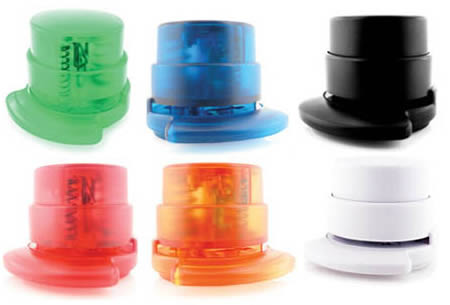

Staples are supposed to be so bad to the environment that a company decided to create a staple-free stapler. This product promises to make collation eco-friendly. Instead of using those thin metal planet-killers, the staple-free stapler "cuts out tiny strips of paper and uses the strips to stitch up to five pieces of paper together." You can even order them customized with your corporate logo so you can, you know, brag about what your company is doing to stop the staple epidemic.


Designer creates an iPhone charger powered by a hand grip

Wednesday, October 13, 2010

Nokia unveils bicycle charger

Nokia unveils bicycle charger
New Delhi: Nokia unveiled its first bicycle charger targeting consumers with limited access to electricity.

The charger kit consists of a charger, dynamo and a holder to secure the phone to the bike. Priced at about 15 euros (Rs 860), the kit will be available later this year, said a company spokesman.

When the kit is installed, the dynamo - a small electrical generator - uses the movement of the wheels to charge the handset through the standard 2mm charging jack used in most Nokia mobile phones.

"Bicycles are the most widespread means of transport in many markets around the world, so this is just one more benefit to be gained from an activity people are already doing. This is a great solution to a real challenge, whether people will use it due to limited access to electricity, or to be more environmentally responsible," says Alex Lambeek, vice president at Nokia.

Designed for tropical climates the Nokia bicycle charger is humidity and dust resistant.

Tuesday, April 20, 2010

Top 10 Green Gadgets

1. Solar Necklace With LED night

An increasing number of companies are looking forward towards using green technology and thus a variety of eco-friendly products appear on the market, highlighting a new stage in the field. What you are currently observing is a necklace called Lux.

The device was designed by May Yokohama. The necklace is composed of a set of small solar panels that accumulate energy during the day and then use this energy at night to power the LED lights that beautifully enrich the necklace. The panels need only a couple of hours to gather enough energy to make the LED lights radiate for four hours. The solar necklace is a simple and yet stylish representative of green technology.


2. Solar-Powered and Bluetooth Headphones

Using the energy of the sun these huge Bluetooth headphones were developed by a student from Transylvania University of Brasov, Shepeleff Stephen. The gadget is dubbed Q-Sound and though the headphones will probably make you feel like some kind of weirdo, they are still unique and most importantly they are eco-friendly.

Q-Sound features solar cells installed across the headband's top. These solar cells can generate power for the two removable rechargeable NiMH batteries, both having a capacity of 800mAh with an operating voltage of 1.2V. The headphones allow you to run Bluetooth and an mp3 player. On a full charge the device can run for up to 40 hours.


3. Solar-Powered Netbook from iUnika

Imaging leaving your netbook with a dead battery on the sun and then discover that its battery is fully charged. This beautiful 1.5 pound netbook could be one of the greatest steps towards dealing with the biggest problems of ultra-portable computers, i.e. battery life. Surely the solar-powered Gyy netbook from iUnika will not be able to run graphics-heavy computer games, but it is still stylish, eco-friendly and inexpensive, being available for just $ 180.

The netbook includes an 8-inch monitor, 400MHz processor and 128MB of RAM. It might not be a powerful computer but it is definitely a unique device made of sustainable components. Its body is made of bioplastics and biodegradable materials that were created from starch and cellulose. The back of the Gyy monitor features solar panels. It is expected that the gadget will hit the stores this summer.


4. Coffee Printer Uses Coffee Grounds to Make Eco Ink for Printer

A great idea for coffee lovers - the RITI Coffee printer, which offers a "green" way of transforming old coffee grounds into sustainable source of ink you can use for you printer. The device simply plugs the leftover grounds from your coffee into an ink cartridge, thus making an environmentally friendly source of ink. If your morning ritual involves a cup of coffee and a newspaper, then you will most likely start looking for this gadget in the stores.


5. Solar-Powered Lunchbox

The idea of developing a solar lunchbox came to Teo Song Wei. This green gadget uses solar energy to keep your food warm, which is very useful if you like to take some food to the office or give some snacks to your kids. It is a very interesting idea, which is yet to be developed, since currently it is just a concept.


6. Solar-Powered Wifi Repeaters

Meraki presented this incredible solar-powered Wi-Fi repeater that can provide Internet access to people in remote regions. The gadget is ideal for national parks and rural areas, being easy to set up and entirely energy-independent. Besides, the gadget is powered by a high-tech solar-charged battery.

This solar repeater is composed of a mesh radio, a solar panel and a pole mount. It is a great way of making Internet available in developing countries, but still the only drawback is the gadget's price that can vary from $ 900 to $ 1500.


7. Solarbulb Uses Old Plastic Bottles as Lamps

This is an original solution for lighting up your garden. The miniWIZ brings you this impressive solar-powered outdoor lamp that features the Hymini Portable Wind Charger. Taking advantage of old plastic bottles, the Solarbulb represents an ingenious solution for night lighting. All you have to do is attach the bulb to a bottle and get 6 hours of non-stop night lighting from 0.18 W solar cells. The LED light starts radiating after its sensors automatically identify the darkness.

It is worth mentioning that the casing of the lamp is both UV-ABS weatherproofed and water resistant, which means you can fill the bottles with water in order to intensify the light and weight the lamp down in case you leave in a windy area.


8. Solar Battery Charger from Energizer

The Solar Battery Recharger is Energizer's new eco-friendly gadget. With its help you can charge both AA and AAA batteries using renewable energy. The gadget can hold several batteries simultaneously.

In addition, in includes a USM port that allow charging a number of mobile phones, GPS devices, cameras, as well as iPods. In case you want to recharge batteries in a cloudy day you can use the Solar battery Charger the usual way, i.e. plug it into an electrical outlet. The device comes with two rechargeable batteries. Quite useful in case you like to travel a lot.


9. Solar-Powered Robotic Lawnmower

This smart garner mower is called RBZG001 Solar Lawnmower Robot. The green gadget charges using solar energy. Besides it takes advantage of network technology in order to add intelligence on its mowing behavior.

Special technology allows the RBZG001 Solar Lawnmower Robot to climb slopes and make out its route automatically. The robot can avoid obstacles with the help of integrated image recognition software. The gadget is surely a good helper for any gardener. Though the price is not known yet, the device is expected to be rather pricey.


10. COM-BAT - Solar-Powered Spy Plane

This gadget was conceived by the United States military as a tool of collecting information for soldiers. The design of the robotic spy plane was dubbed COM-BAT. The Army gave engineers at the University of Michigan College of Engineering a $ 10 million grant to create the bat-shaped spy plane in five years. COM-BAT would be powered by the sun, wind and vibrations.

Engineers will use the grant to built a Center for Objective Microelectronics and Biomimetic Advanced Technology (COM-BAT) that will create sensors, communication equipment, as well as batteries for the spy-plane. Some of the concepts for the bat include miniature cameras for stereo vision, a series of mini-microphones able to follow sounds coming from different directions, and tiny detectors able to identify nuclear radiation and poisonous gases.


In addition, the plane will feature "quantum dot solar cells" that have the capacity two times that of photovoltaics. COM-BAT will also include an independent navigation system that is 1,000 times smaller than the systems used today.

Get Cash for Recycling Your Cell Phone

It’s estimated that just 1 percent of the 4 billion wireless users worldwide recycle their cell phones after use.

A new company, eRecyclingCorps, believes the low recycling rate may have something to do with convenience. Make it more convenient for people to recycle those phones – while offering a financial reward at the same time – and recycling participation may increase.

The program has created a simple way for companies to reward consumers at the point of sale for recycling their used mobile phones.

Currently implemented in more than 2,500 retail locations, the program allows consumers to receive discounts on retail purchases equivalent to the value of their used handset device.

A recent research study found that 98 percent of consumers who had not yet recycled their handsets indicated they were willing to, but only in return for some compensation, whether that be cash, store credit or a tax deduction.

“The message is clear,” said ABI Research technology industry analyst Michael Morgan. “Many consumers in the U.S. are prepared to help the environment by recycling their old handsets, but only if there is a financial incentive to do so. Virtue is not the reward in this case. Operators wishing to present a ‘green’ public face – and the survey’s results also show that consumers increasingly favor those that do – should factor these attitudes into their recycling schemes.”

Though we’re not advocating consumers only recycle when rewarded, it is important to try and find reasons why cell phone recycling remains consistently low year after year, despite dramatic increases in recycling programs. If convenience and incentive are reasons that could lead to increased recycling, this program and others like it, may just be on to something.

eRecyclingCorps was started by industry experienced individuals, including the former CEO of RadioShack and the former President and COO of Sprint, both whom have seen the ecological consequences of the wireless industry’s success.

“The unprecedented growth in the global wireless industry has transformed the way people live, work and play,” said eRecyclingCorps Founder and CEO David Edmondson. “The unintended consequence of that growth is a mountain of toxic environmental e-waste.”

http://www.Cellitused.com is another great place to recycle phones and ipods or electronics, they just launched a new web site that is very user friendly!

http://www.avbrecycle.com for all your Cell Phone and Inkjet Recycling needs.

Fake Products Receive Energy Star Certification

According to a recent government report, 15 fake products received Energy Star certifications, including a 1.5 foot-tall gas-powered alarm clock and an “air room cleaner” (actually a space heater with a feather duster and fly strips attached).


Investigators from the U.S. Government Accountability Office (GAO) submitted 20 bogus products to the Energy Star program, which is operated by the EPA and Department of Energy (DOE), for labeling as energy-efficient consumer products. Fifteen of the products passed these specification guidelines:
- Product categories must contribute significant energy savings nationwide.

- Qualified products must deliver the features and performance demanded by consumers, in addition to increased energy efficiency.

- Energy efficiency can be achieved through broadly available, non-proprietary technologies offered by more than one manufacturer.

- Product energy consumption and performance can be measured and verified with testing.

The GAO, the investigative arm of Congress, concluded the program to be “a self-certification program vulnerable to fraud and abuse,” due largely to the fact that Energy Star does not verify claims made my manufacturers.

Senator Susan Collins of (R-Maine), ranking member of the Senate Homeland Security and Governmental Affairs Committee, requested the study.

The EPA and DOE did respond to the GAO report in a joint news release, outlining the course of action they will take in order to rectify the situation.

“The steps we’re taking now will further strengthen and improve the program, building on the results that consumers have come to expect,” said Cathy Zoi, DOE assistant secretary for Energy Efficiency and Renewable Energy.

The outlined steps include both testing and enforcement actions, including an expanded system that will require all products seeking the Energy Star label to be tested in approved labs.

Monday, April 19, 2010

The World’s Cheapest Car, Tata Nano: Boon or Bust for Environment?

The astoundingly cheap Nano is priced to sell at around $2,500 US, a price most of the middle-class in India can afford. Head of Tatan Motors, Ratan Tata, predicts the car will revolutionize travel in India, getting millions of Indian middle-class off dangerous motorcycles and into cars.

The Nano's Interior

Keep in mind, however, for only $2,500 you don’t get too many features: no power steering, no ABS, only one side mirror, and it tops out at about 65 mph. On the other hand, there is a feature those of us concerned about global warming might like. The car averages 45 mpg in the city and 75 mpg on the highway. Those aren’t bad numbers.

Yet, the possibly huge influx of cars this price tag represents around the world makes the environmental impact of the Nano look a little less positive. We are talking about MILLIONS of new cars. No matter how low the mpg’s, that will definitely add to already treacherous CO2 levels. Aren’t we supposed to be discouraging car purchases?


But then again, what can we say when the US is recklessly irresponsible in its gasoline consumption and automobile driving. Not to mention, the Nano presents the possibility of literally millions of people previously unable to afford cars getting behind the wheel at a relatively friendly mpg and GHG level. And this alone could beneficially stimulate the Indian economy in countless ways, resulting in the financial stability necessary to support more responsible environmental practices in a notoriously dirty country. Better small, green cars than SUVs, right?

What do you think? World’s cheapest care, boon or bust for environment?

How eco-friendly is Mobile Internet?

Nokia says that updating your Facebook status from a mobile phone consumes about 100 times less energy than if you were to do the same activity from a desktop PC.

Also, if only 100 million people were to use mobile phones instead of desktop computers to browse the Internet one hour a day, the amount of energy saved would be roughly equivalent to the annual greenhouse gas emissions of 430,000 cars.

There are about 1.4 billion Internet users worldwide and around 46% of them use Internet from both PC and their mobile phones according to this chart from DataViz.

Friday, April 16, 2010

Toyota Highlander FCHV-adv: Travel 431 Miles On A Single Tank of H2.

It’s going be hard for Ford, Cadillac and other SUV manufacturers to tout their 18mpg “Green” vehicles in commercials and in print ads once the Toyota Highlander FCHV-adv hits the roadways. A vehicle that can handle 431 miles on a single 6 kilogram tank of H2. A number equal to 68.3 miles/kg when compared to miles per gallon.

According to AutoblogGreen, “Toyota representatives and others drove two FCHV-advs from Torrance to San Diego and back, a 331.5 mile trip, and then calculated how much H2 was left in the 10,000 psi tank.”


It was also announced by a Toyota representative that the company plans on bringing a durable fuel cell vehicle to market by 2015. That’s not even the best news, there are claims that the vehicle will be priced “shockingly low” for consumers.

Currently tests are still underway in California, which means fuel economy may increase at an even greater rate before Toyota releases their first H2 capable automobiles.

So just remember, when commercials are touting 18 miles per gallon SUV’s their about 4 times behind the fold, not to mention the government calls 18mpg vehicles “Clunkers” in their new “CARS” program.

Wednesday, April 14, 2010

Solar Powered Air Conditioners Coming To US Homes (Soon!)

Solar Powered Air Conditioners Coming To US Homes (Soon!)

Even though we are nearing the end of Summer, in many cities and states heat is still bearing down at full throttle.

And most homes in the US use air conditioners to cool off. In fact, most Americans use air conditioners to the tune of 16% of the total energy in the US. So obviously this is a huge market in the HVAC niche, which environmentalists and green minded entrepreneurs are rushing off to make more eco friendly. I don’t foresee anytime soon a plethora of middle Americans dumping their A/C, as this has been the norm for too long and most don’t know what to replace their A/C with. But there is growing awareness of the need to use less energy and to at least try energy-efficient cooling systems, and Americans are starting to seriously pay attention to this big energy hog.

However there is good news. A company named ChromaSun is making strides in this area and has a prototype in the works to bring a highly efficient earth-friendly air conditioner to US homes.

Their first revolutionary product is a Solar Powered Air Conditioner. This 10 foot long by 4 foot wide box (for lack of a better word) would cost about $15.52 a kilowatt hour to operate compared to $27.69 for an electrical air conditioner. And would cool off an average 1,500 square foot room with ease, according to ChromaSun. As the name suggests, the a/c would be powered by the Sun. The light from the sun would be converted to heat, which would then be converted to electricity. So you could potentially (very soon) cool off your home entirely off-grid. Or mostly off-grid anyway.

The cost has not yet been determined, nor a release date set on this solar-powered air conditioner, but keep an eye on ChromaSun—as they have a pulse on this massive and exciting industry.

Thursday, March 25, 2010

We’ve Got Paper Cups—Why not Bottles?

Hey, look at this cool paper bottle from BrandImage! It may be leading the revolution against plastic.

The “forever in a landfill” environmentalist slogan is quickly becoming cliché and lost on the general public. Each day, Americans continue to throw out 60 million plastic bottles. Only 14% of which actually get recycled. So, forget landfill slogans. We aren’t getting it done.


plastic1Try this on for size: there exists an island of garbage out in the Pacific Ocean the size of Texas? Texas! Due to some interestingly dull oceanographic factors, nearly all of the refuse jettisoned into the Pacific meanders its way over to become trapped in the same area. Also, plastic is incapable of degrading. Not only has this resulted in a pile of trash larger than I am even capable of comprehending, but it will apparently never go away. Ever. Plastic does, however, break down physically into smaller and smaller bits until it resembles tasty krill. Krill is what a very large portion of sea life eats. So, you see the problem.


Plastic is an amazing substance that makes our activities more convenient and saves perhaps billions of lives through food packaging and medical equipment. Plastic has a variety of wonderful properties and high up on that list is the fact that it doesn’t break down. It doesn’t whither or turn bad. It doesn’t chemically react with food or medicine or anything really. But there is the problem. A substance that cannot be broken down by any environmental exposure and cannot be eaten by anything will fill its little nook in the world FOREVER.

A few decades of intense marketing for plastic made it out to be the end-all miracle material (which, it may be), but many great designers and high-end businesses are finally breaking out of that rut and embracing paper.

We are beginning to realize again that there is no loss of class in paper products. Even glass is seeing a packaging decline. Many fine mid-range wine makers have begun adopting boxes in addition to or instead of glass bottles.

The 360 Paper Bottle, for example, is a far more sustainable approach to water bottles and packaging in general. It is totally recyclable paper made from 100% renewable resources. The lining uses biodegradable PLA film. The end result is entirely food-grade material. The 360 Paper Bottle meets all criteria for all liquid categories and is sturdy enough for a variety of applications and multiple reuse. The paper bottle design has had a good critical and market response, including having received an IDEA (International Design Excellence Award) for this design.


Eco experts and enthusiasts will always stress the value of reusing, so keep in mind that filling the same bottle every day is far superior an option than even the most environmental paper alternative. However, we still applaud this great paper design and hope that it sparks the about-face of old industry packaging standards across the board. If we can get all packaging to be made from eco-friendly materials in the first place, then the collective hazardous waste and energy consumption could go down dramatically.

Wednesday, March 24, 2010

When Winter Returns, Cut Energy While Staying Warm

Using a small and efficient space heater instead of central heating can save a lot of money by allowing you to heat localized areas while appropriately neglecting others. There is no point in heating your living room when you are sleeping is there? Well, maybe you’ve been kicked out of the bedroom, but that advice column is for another website. The point is that eliminating the energy wasted on unused space is a great way to cut utility bills and, more importantly, save electricity.


A small unit mounted on wheels can be easily moved from room to room along with you while still being powerful enough to heat large areas. For example, the Honeywell HZ-315 weighs just under 3.5 pounds but can pump out 1,500 watts of efficiently distributed heat. This model also costs only $25 (USD). Honeywell space heaters come well recommended but really are indicative of what is available in general. Your local home supply store should have a variety of makes and models that are roughly the same power to cost ratio.

With the central heating turned off and your cozy space heater cranked up, you’ll be saving utility money every second you sleep. I estimate that your space heater will pay for itself after a single month of winter use.

Friday, March 19, 2010

Daimler Chrysler To Release Emission Free Smart Car

Zero to 60MPH in 6.5 seconds, a sleek design that’s compact but stylish and plenty of torque – no, we’re not talking about the newest Porsche. This is the Daimler Smart Ed, a zero emissions, super eco-friendly smart car.

Refilling Smart Car The Smart Ed features a range of 71 miles using a Tesla provided 14 Kwh lithium-ion battery, while the cars 30kW electric motor pushes out an impressive 120 Newton metres of torque.

Originally the Smart Ed was set for an Early 2010 release, now Daimler has announced that their Hambach, France plant will have them ready to go by November 2009.


Smart Car Guage

Unfortunately due to extensive testing that still needs to be completed throughout European cities they won’t be readily “available to anyone interested” until 2012. Of course by 2012 I’m pretty sure 71 miles on a single charge will seem ridiculously out of touch with current models available at that time.